




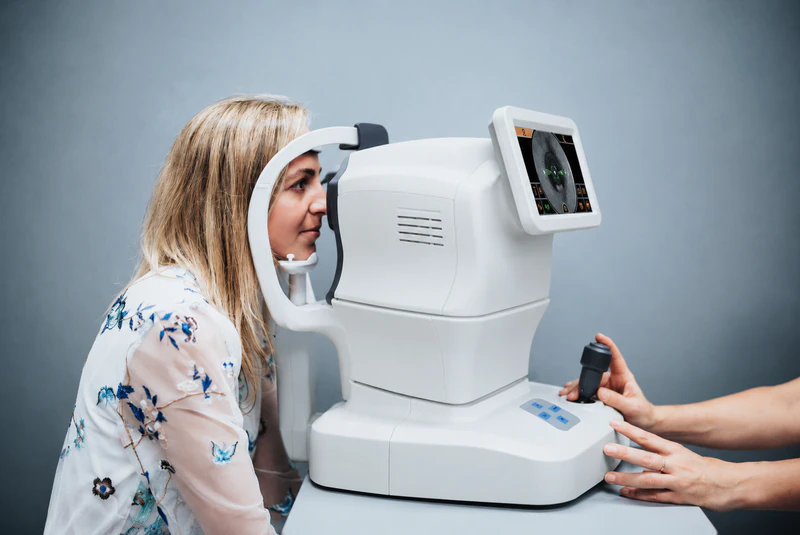
A practical non-contact (air-puff) tonometer shortlist for 2026 includes Topcon, NIDEK, Reichert, Keeler, and LINKEYE. Each addresses different purchasing priorities, from integrated corneal thickness measurement to handheld operation and distributor support. Choose instruments for intraocular pressure (IOP), it is recommended that a comprehensive consideration be given to measurement functions, repetition, patient applicability, after-sales service support, and total cost of ownership.
Non-Contact (Air-Puff) Tonometer Brands at a Glance
| Brand | Representative model | Main reason to shortlist |
|---|---|---|
| Topcon | CT-800 | Desktop operation with LAN export |
| NIDEK | NT-1p | Automated tonometry with integrated pachymetry |
| Reichert | 7CR | Corneal Compensated IOP reporting |
| Keeler | Pulsair IntelliPuff | Handheld measurement with a separate base |
| LINKEYE | NCT-5000AB | Automated operation and B2B configuration support |
Note:This guide compares published features rather than presenting an independently tested performance ranking. Availability and configurations vary by market.
5 Brands Worth Comparing
Topcon: Established Desktop Workflow
The Topcon CT-800 combines an 8.5-inch touchscreen, joystick operation, a built-in printer, and LAN export. It calculates adjusted IOP from manually entered pachymetry values; this does not mean it measures corneal thickness itself.
Shortlist it when staff prefer a conventional desktop layout. During evaluation, check patient positioning and demonstrate data export into the system your practice actually uses.
NIDEK: Integrated Corneal Thickness Measurement
The NIDEK NT-1p combines non-contact tonometry with pachymetry. Its fully automated mode detects eye position, while Automatic Puff Control adjusts subsequent air pressure using previous measurements.
The distinction between models matters: the NT-1p measures corneal thickness, whereas the NT-1 accepts manually entered thickness values for adjusted IOP. This makes the NT-1p worth evaluating when both measurements belong in your routine workflow.
Reichert: Corneal Response Technology
The Reichert 7CR reports Corneal Compensated IOP, or IOPcc, using bidirectional applanation. Its published measurement range is 7–60 mmHg, and its automatic alignment and triple-measurement mode support repeat readings.
Consider this non contact tonometer when corneal biomechanical influences are a specific evaluation priority. IOPcc is a distinct measurement output; it should not be treated as interchangeable with every conventional IOP result.
Keeler: Handheld Air-Puff Operation
The Keeler Pulsair IntelliPuff uses a handheld measuring unit and a separate base that can be placed on a desk or wall-mounted. It avoids the need to position patients in a fixed chinrest.
This arrangement deserves attention where access or room layout makes desktop testing awkward. However, handheld does not mean cordless: the system is electrically powered, so assess power access and handling during a demonstration.
LINKEYE: Automated Testing and Procurement Support
LINKEYE’s NCT-5000AB lists a 0–60 mmHg range, three-reading averaging, automatic alignment, focusing, and eye switching. Its specification also lists thermal printing and DICOM 3.0 connectivity.
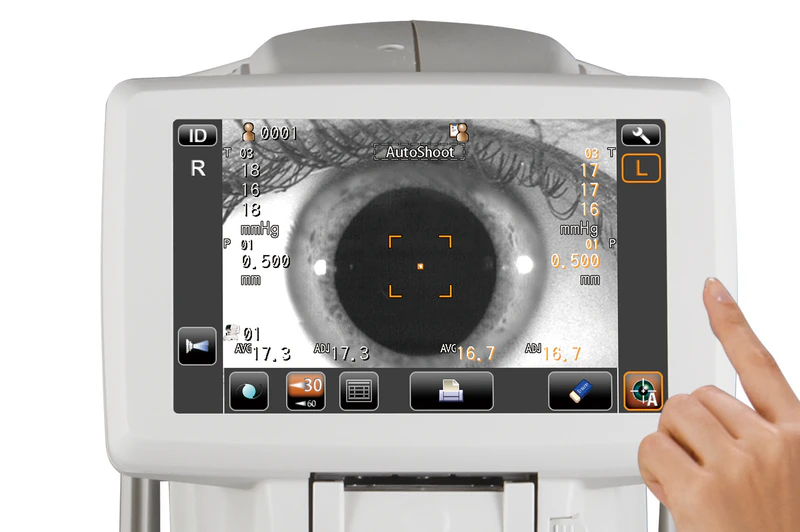
The range includes different configurations, so confirm pachymetry on the exact model quoted. LINKEYE also offers video demonstrations, free online training, installation support, and distributor customization options. These provisions are relevant when purchasing multiple units or building a local equipment distribution business.
Confirm the Delivered Configuration
Request the model suffix, included accessories, software functions, warranty terms, and service responsibilities in writing. Where DICOM integration matters, ask for a conformance statement and test compatibility before acceptance.
How Should You Choose a Non-Contact (Air-Puff) Tonometer?
Select according to clinical requirements and demonstrated performance, then compare complete quotations.
- Verify repeatability. Request validation evidence and repeated measurements; a broad pressure range alone does not establish accuracy.
- Examine patient access. Assess chinrest travel, wheelchair positioning, operator reach, and tolerance of the air pulse.
- Specify corneal measurements. Distinguish built-in pachymetry, manually entered thickness adjustments, and biomechanical compensation.
- Test connectivity. Confirm supported interfaces, patient identifiers, export formats, and any additional integration charges.
- Evaluate ownership costs. Include training, calibration, servicing, printer supplies, freight, taxes, and potential downtime.
Compare the complete examination sequence, not only the acquisition time printed in a brochure. Ask staff to position a patient, obtain acceptable readings, export the report, and prepare for the next examination. This reveals practical differences in alignment, recovery after a failed reading, and assistance required from an experienced operator.
A hospital department may prioritize interoperability and local response times, whereas a distributor must assess replacement parts availability, training coverage, and documentation across its sales territory. Individual equipment buyers should confirm intended professional use and qualified operation rather than assuming these devices are suitable for unsupervised home monitoring.
For a more detailed purchasing checklist, read What to Check Before Buying a Non-Contact Tonometer.
Clinical Context Behind the Purchase
A non contact tonometer supports IOP assessment, but pressure alone does not diagnose glaucoma. NICE NG81, recommendation 1.1.2, published in 2017, states: “Do not base a decision to refer solely on IOP measurement using non-contact tonometry.”
Accordingly, procurement should support the wider examination pathway, including access to Goldmann-type applanation measurements where clinically indicated.
Frequently Asked Questions
Which Non-Contact (Air-Puff) Tonometer brand is best?
- Choose NIDEK NT-1p when integrated pachymetry is required.
- Evaluate Reichert 7CR when IOPcc reporting is relevant.
- Compare LINKEYE when automation and distributor support are purchasing priorities.
Is every handheld tonometer an air-puff device?
- No, not every handheld tonometer is an air-puff device. Handheld describes the instrument’s format.
- Keeler Pulsair IntelliPuff uses an air pulse.
- Rebound instruments use a contacting probe and belong to a different category.
Does corneal thickness correction replace clinical interpretation?
No, mathematical corneal thickness correction does not replace clinical interpretation
How much should buyers budget?
- Obtain quotations for the same features and accessories.
- Separate equipment price from delivery and service costs.
- Request current LINKEYE pricing for the intended model and destination.
What should distributors request before ordering?
- Obtain model-specific documentation for the destination market.
- Confirm spare parts, training, and warranty arrangements.
- Agree on minimum quantities, customization, and delivery terms.
Conclusion: Best Choice for Your Practice
The best non-contact (air-puff) tonometer is the model that meets your clinical needs and can be supported reliably. Prioritize integrated pachymetry, IOPcc, or handheld access only when those functions serve your workflow.
For automated clinic equipment and B2B sourcing, explore LINKEYE’s tonometer range. Please provide your country, region, application scene, quantity and required features for custom quotations or video demos.


