







The non-contact tonometer should provide repeatable eye pressure readings, fit the clinic’s patient flow, and meet local regulatory requirements. Before purchasing, check its measurement data, pressure range, corneal thickness function, alignment system, data connectivity, calibration process, warranty and technical support. If readings drift or repair difficulties, even if the offer is low, it doesn’t make much sense.
Why Does Tonometer Selection Require Care?
Intraocular pressure, or IOP, is a core measurement in glaucoma screening and follow-up. The need is not getting smaller: researchers estimated that 111.8 million people aged 40–80 could have glaucoma by 2040 (Tham et al., Ophthalmology, 2014).
Tonometer selection requires care because choosing the wrong device can lead to inaccurate intraocular pressure (IOP) readings, compromise patient safety, or prove impossible to use given a patient’s physical limitations. Because elevated eye pressure is the primary modifiable risk factor for glaucoma, small measurement errors can drastically alter a patient’s treatment plan or delay a life-saving diagnosis. Therefore, consumers should assess the reliability of the measurement system before being drawn to smart screens.
What Should You Check Before Buying?
Yes, technical specifications matter, but the brochure should be the start of the discussion—not the end.
- Measurement evidence: Ask for repeatability data and agreement with Goldmann applanation tonometry across low, medium, and high IOP ranges. A 2025 multicenter study found that one automated model performed differently at pressure extremes despite a small overall mean difference (Chaglasian et al., 2025).
- Corneal thickness capability: Central corneal thickness and curvature can affect air-puff tonometry results. Research has documented this relationship for both non-contact and Goldmann measurements (Harada et al., Journal of Glaucoma, 2008). An integrated pachymeter can therefore provide useful clinical context.
- Measurement range: Confirm that the non-contact tonometer covers routine screening and unusually high readings. Also check the display increment, automatic averaging method, and error warnings.
- Compliance documents: Request certificates for the exact model and destination market. ISO 8612 defines minimum requirements for clinical tonometers and was reconfirmed in 2024. US buyers should also verify the relevant FDA listing or clearance rather than accepting a generic “FDA” logo.
Accuracy Is Not the Same as Resolution
A Practical Purchasing Rule
A display resolution of 1 mmHg does not prove clinical agreement within ±1 mmHg. Ask for Bland–Altman limits of agreement, test–retest results, and the number of subjects used in validation. In plain English: repeat the measurement and see whether the device tells the same story.
When Is Non-Contact Tonometry Not Enough?
Unexpected readings should be repeated and reviewed under the clinic’s protocol. Patients with prior corneal surgery, keratoconus, unusual corneal thickness, poor fixation, or very high IOP may need confirmation with another method. A non-contact tonometer is excellent for fast measurement, but it should not be treated as a stand-alone diagnostic system.
An eye care specialist must transition to a contact method:
Pressures Outside the Normal Range (10–20 mmHg)
High-Pressure Ranges: At higher intraocular pressures (IOP), the cornea becomes highly resistant. Studies show that air puff machines significantly underestimate high pressures, creating a dangerous false sense of security.
Low-Pressure Ranges:Conversely, NCT tends to overestimate pressures at the lower end of the spectrum, which can trigger false alarms and unnecessary testing.
Structural and Corneal Abnormalities
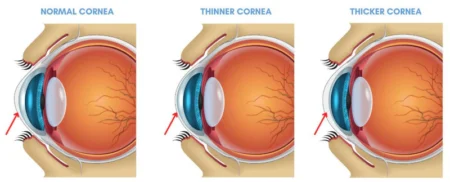
Thick or Thin Corneas: Thicker corneas require a stronger puff of air to flatten, falsely reading as high pressure. Thin corneas flatten too easily, masking dangerously high internal pressure.
Prior Laser Eye Surgery: Procedures like LASIK permanently thin and alter the shape of the cornea. Air puff tests on post-LASIK eyes consistently deliver artificially low readings.
Corneal Pathologies: Patients with high astigmatism, corneal scarring, or irregular surface curvature break up the air puff uniformly, making the automated digital reading highly unreliable.
What Does LINKEYE Offer?
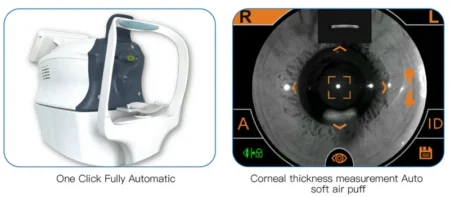
The LINKEYE NCT-5000AB non-contact tonometer provides a 0–60 mmHg range, three-reading averaging, 3D autofocus, automatic eye switching, a safety limit, thermal printing, and DICOM 3.0 connectivity. The NCT-5000B version also lists corneal thickness measurement from 400 to 800 μm. For clinics needing automated measurement, pachymetry, and DICOM connectivity, the LINKEYE NCT-5000AB series is worth evaluating against local clinical and regulatory requirements.
Conclusion
The best choice is a clinically validated tonometer that delivers consistent readings, fits the clinic’s daily workflow, and has dependable technical support. Buyers should confirm model-specific certification, software compatibility, training, and local service terms before ordering.


