




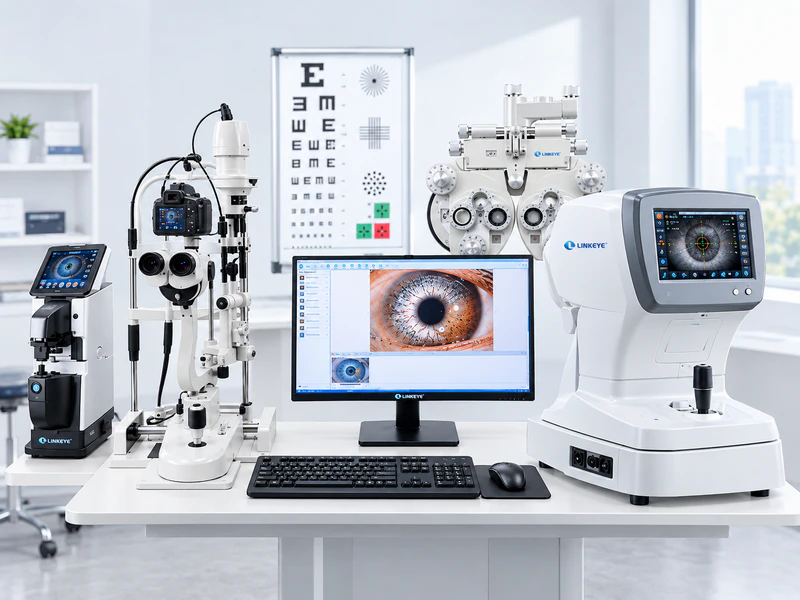
Optometrists use various optical testing equipment and diagnostic instruments to measure vision, determine refractive errors, examine the eye, and identify conditions that may require further care.Common optometry equipment includes an autorefractor, phoropter, slit lamp, tonometer, lensmeter, retinoscope, trial lens set, and visual acuity chart. More advanced practices may also use OCT, corneal topographers, retinal cameras, and visual field analyzers.
What Equipment Do Optometrists Use?
Clinics typically use multiple types of optometry instruments, as no single device provides a comprehensive eye examination.
The equipment can be divided into four main groups:
| Equipment Category | Common Instruments | Main Purpose |
|---|---|---|
| Vision Testing | Visual acuity chart, near vision tester, PD meter | Measures visual performance |
| Refraction | Autorefractor, phoropter, retinoscope, trial lenses | Determines refractive correction |
| Eye Examination | Slit lamp, ophthalmoscope, tonometer | Examines ocular structures |
| Advanced Diagnosis | OCT, retinal camera, visual field analyzer, corneal topographer | Detects and evaluates eye conditions |
A primary optometry clinic may require a smaller configuration, while a larger eye-care center may need advanced imaging and diagnostic systems.The specific list of equipment depends on the scope of practice.
The College of Optometrists includes a slit-lamp biomicroscope, retinoscope, focimeter, keratometer, visual field equipment, visual acuity charts, trial lenses and trial frames among the equipment for routine eye examinations. It also lists autorefractors, corneal topographers, fundus cameras, and OCT as additional equipment that may be appropriate for certain practices.
What Equipment Is Used for Vision Testing?
Visual acuity is usually one of the first measurements in an eye examination. It determines how clearly a patient can see at a specified distance or near range.
Visual Acuity Chart
A visual acuity chart displays letters, symbols, numbers, or other targets at a controlled viewing distance.
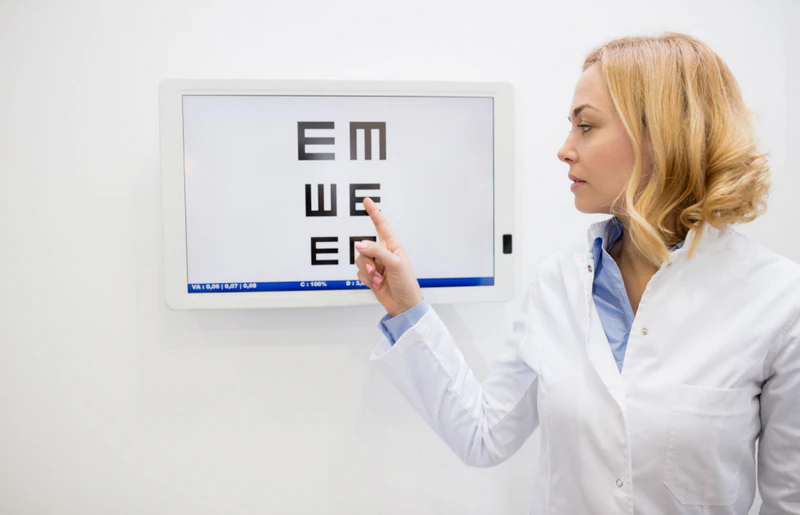
Modern practices may use:
- Digital LCD charts
- Projected charts
- Distance vision charts
- Near vision charts
- Pediatric or language-independent charts
Digital charts provide flexibility because the optometrist can change the displayed test according to the patient’s age, language, or examination requirements.
Near Vision Tester
Near vision testing evaluates the patient’s ability to see objects at close range. It is particularly relevant when assessing presbyopia and determining near-vision prescriptions.
PD Meter
A pupillary distance meter, or PD meter, measures the distance between the pupils. Accurate PD measurement is important when preparing prescription lenses because incorrect positioning can affect optical performance.
How Do Optometrists Measure Refractive Errors?
Refraction determines whether a patient requires corrective lenses and helps establish the appropriate prescription.
Several instruments can be used together.
Autorefractor
An auto refractometer provides an objective estimate of refractive error by analyzing how light behaves as it enters and returns from the eye.
It can provide measurements related to:
- Sphere
- Cylinder
- Axis
- Refractive error
The autorefractor does not replace the complete subjective refraction. Instead, its measurement gives the optometrist a useful starting point for refining the prescription.
Phoropter
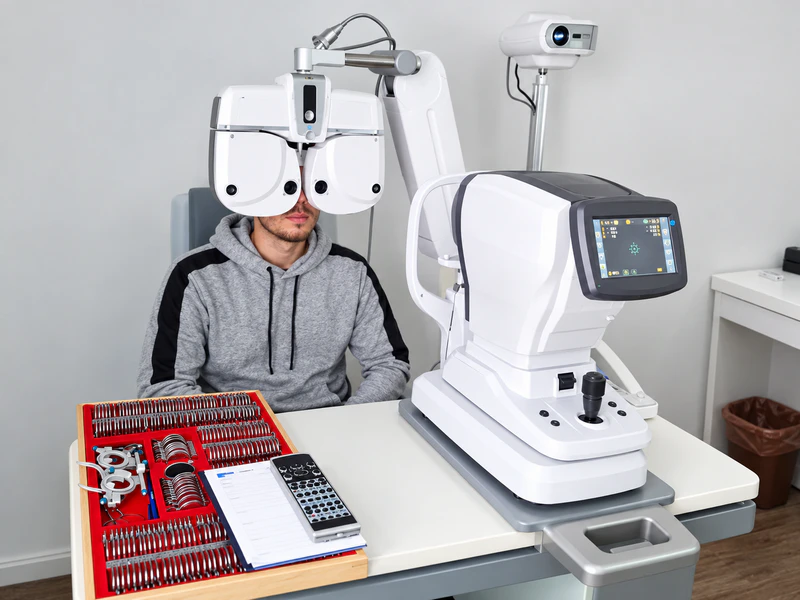
A phoropter contains multiple lenses that can be presented to the patient during subjective refraction.
The optometrist changes lens combinations and asks the patient to compare different views. This helps determine which prescription provides the clearest and most comfortable vision.
Both automatic phoropters and manual phoropters are used in professional practices.
Retinoscope
A retinoscope allows the practitioner to objectively estimate refractive error by observing the movement of reflected light from the patient’s eye.
It remains particularly useful when automated measurements are difficult or when working with certain patient groups.
Trial Lens Set and Trial Frame
Trial lenses provide a manual method for testing different spherical, cylindrical, and other optical corrections.
A trial frame holds selected lenses in front of the patient’s eyes. This approach remains valuable for confirming prescriptions and for situations where automated equipment is unavailable.
Which Equipment Is Used to Examine the Eye?
Refraction tells the practitioner how well a patient sees and what correction may be needed. A complete examination also requires assessment of the eye itself.
Slit Lamp
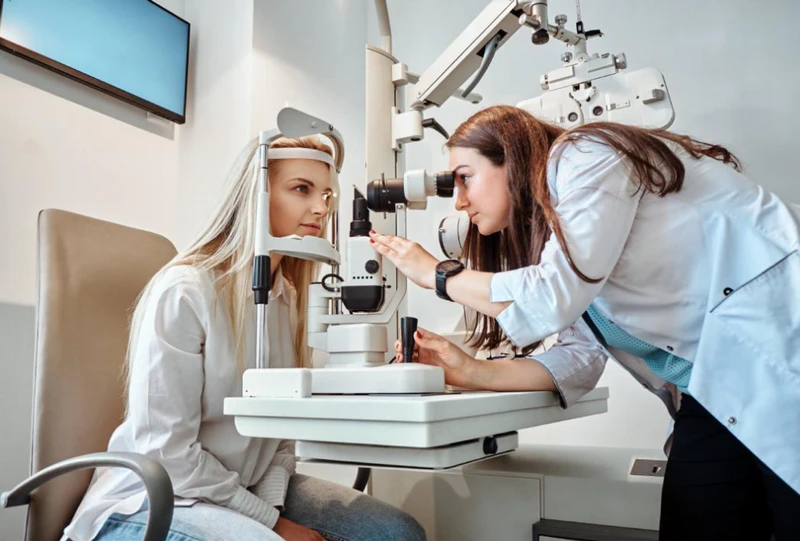
A slit lamp is one of the most important examination instruments in optometry.
It combines a high-intensity light source with magnification, allowing the practitioner to examine structures such as:
- Cornea
- Conjunctiva
- Anterior chamber
- Iris
- Lens
- Eyelids and surrounding structures
Digital slit lamps can also capture and store images for documentation and follow-up.
Tonometer
A tonometer measures intraocular pressure (IOP).
IOP measurement is an important component of glaucoma assessment. Non-contact tonometers are commonly used for screening, while applanation tonometry can provide more direct measurement depending on the clinical setting.
The College of Optometrists notes that non-contact tonometers are suitable for screening, while contact applanation tonometers are preferred for referral and enhanced pathways.
Ophthalmoscope
A direct or indirect ophthalmoscope enables examination of internal ocular structures, particularly the retina and optic nerve.
Portable ophthalmoscopes are also useful for outreach services and examinations outside a conventional consulting room.
What Advanced Diagnostic Equipment Do Optometrists Use?
Not every optometry practice needs advanced imaging equipment. However, these technologies can expand diagnostic capabilities and improve documentation.
OCT Machine
Optical Coherence Tomography (OCT) produces high-resolution cross-sectional images of ocular structures.
It is widely used to assess the retina, optic nerve, and other structures. OCT is particularly valuable when monitoring patients over time because repeated scans can be compared.
According to Grand View Research’s 2026 market estimate, the global eye examination equipment market is projected at approximately US$4.5 billion in 2026, with OCT scanners representing the largest product segment in its 2024 analysis at 17.5% of the market.
Retinal Camera
A retinal camera captures images of the fundus. These images can support documentation, screening, referral, and longitudinal monitoring.
Some modern systems are designed for non-mydriatic imaging, which can simplify routine retinal photography.
Visual Field Analyzer
A visual field analyzer measures the patient’s field of vision and can help identify functional abnormalities.
It is particularly relevant in glaucoma assessment and monitoring.
Corneal Topographer
A corneal topographer maps the shape and curvature of the cornea.
It can be useful for:
- Contact lens fitting
- Corneal assessment
- Irregular astigmatism
- Refractive surgery evaluation
- Keratoconus monitoring
How Does the Equipment Work Together During an Eye Examination?
Optometry equipment is most effective when used as part of a structured workflow rather than as isolated instruments.
A typical sequence may include:
- Visual acuity testing — Establishes baseline distance and near vision.
- Autorefraction — Provides an objective starting measurement.
- Subjective refraction — Uses a phoropter or trial lenses to refine the prescription.
- IOP measurement — Evaluates intraocular pressure.
- Slit-lamp examination — Examines anterior eye structures.
- Retinal assessment — Uses an ophthalmoscope, retinal camera, or other imaging technology when indicated.
- Additional testing — OCT, visual field analysis, or corneal topography may be performed according to the patient’s needs.
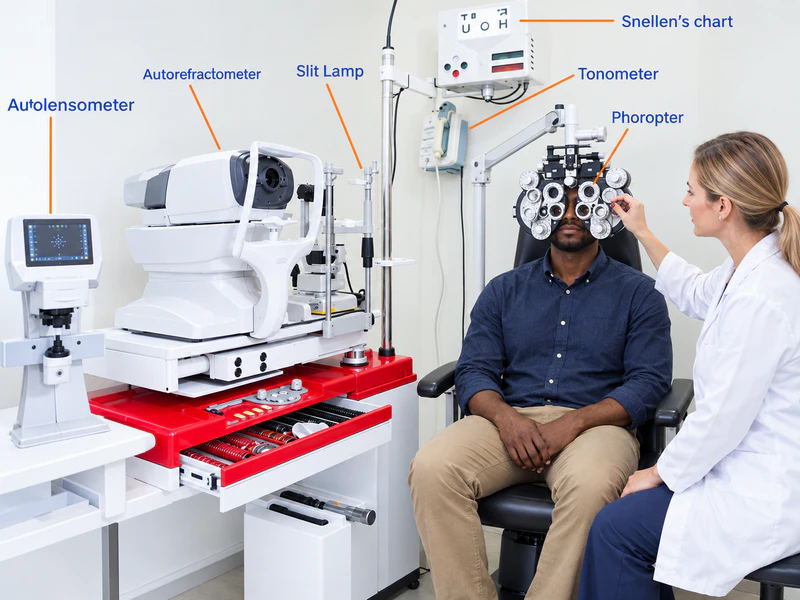
This workflow illustrates an important procurement principle: equipment should be selected according to clinical workflow, not simply according to the number of features listed in a product specification.
What Equipment Does a New Optometry Practice Need?
A new practice does not necessarily need every advanced instrument from the beginning.
Essential equipment usually includes:
- Autorefractor for objective refraction
- Phoropter for subjective refraction
- Slit lamp for ocular examination
- Tonometer for IOP measurement
- Lensmeter for verifying existing lenses
- Visual acuity chart for distance and near vision
- Trial lens set and trial frame for manual refraction
- Ophthalmoscope or retinoscope for ocular assessment
Additional equipment can then be added according to patient volume, clinical services, and budget.
For example, a practice offering myopia management may require additional corneal or biometric assessment capabilities. The American Optometric Association has identified the phoropter, slit lamp, retinoscope/autorefractor, keratometer/auto-keratometer, and appropriate fitting sets as equipment relevant to myopia management.
How Should Optometrists Choose Equipment?
The right equipment depends on the clinical service, patient population, and workflow.
What should you consider before purchasing?
- Clinical purpose — Select equipment according to the examinations actually performed.
- Measurement accuracy — Check specifications, repeatability, and calibration requirements.
- Workflow efficiency — Automated functions can reduce repetitive manual procedures.
- Ease of operation — Equipment should be practical for daily use and staff training.
- After-sales support — Confirm warranty coverage, spare parts, maintenance, and technical assistance.
In addition, buyers should verify applicable regulatory documentation and quality certifications before purchasing medical devices for professional use. Our article, “How to Choose Optometry Equipment for Sale in Your Clinic” provides a detailed guide on selecting optometry equipment for your clinic.
What Equipment Does Shanghai LINKEYE Supply?
Shanghai LINK Instruments Co., Ltd. has manufactured ophthalmic and optical instruments in Shanghai since 2009.
Its product range covers three major areas:
Optometry Equipment
- Auto Refractometers
- Auto and Manual Lensmeters
- Auto and Manual Phoropters
- Auto Chart Projectors
- Trial Lens Sets
- Trial Lens Frames
- PD Meters
- Vision Screeners
- Combined Ophthalmic Units
- Retinoscopes and Ophthalmoscopes
- Near Vision Testers
Ophthalmic Equipment
The portfolio also includes OCT Machines, Ultrasound Scanners, Tonometers, Retinal Cameras, Corneal Topographers, Slit Lamps, Visual Field Analyzers, and other ophthalmic systems.
Optical Lab Machinery
For practices or optical businesses that also process prescription lenses, Shanghai LINK supplies Auto Lens Edgers, Hand Lens Edgers, Grooving Machines, Lens Drilling Machines, Lens Testers, Frame Warmers, and other optical laboratory machinery.
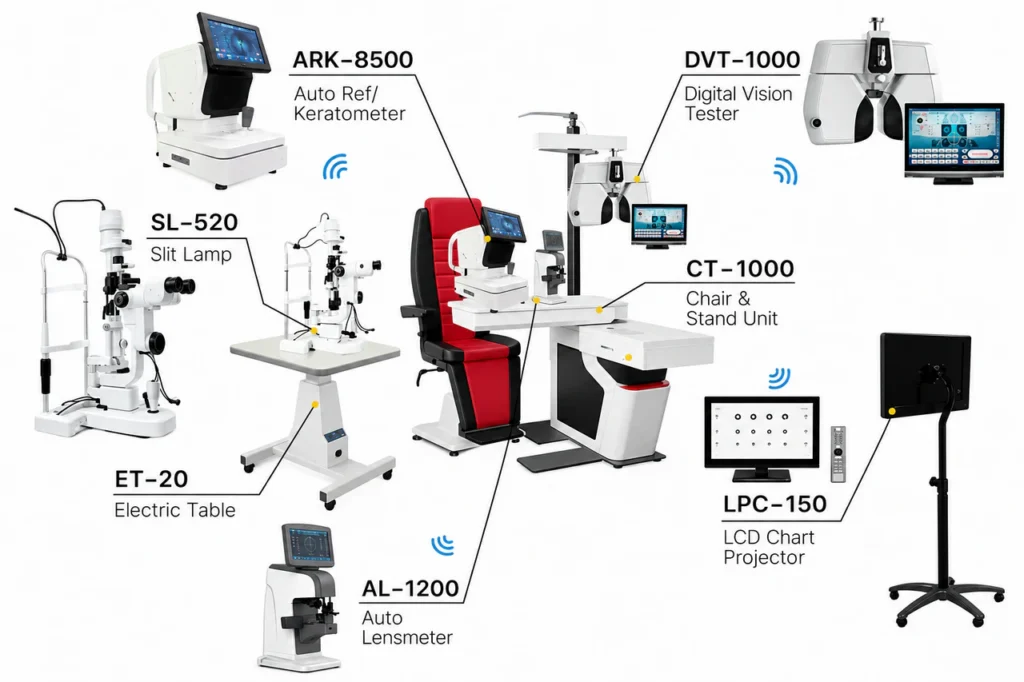
Shanghai LINK official website
The company states that its manufacturing system integrates R&D, design, production, and quality control, with certifications including ISO 9001 and ISO 13485, alongside applicable CE and FDA certifications for its products.
Frequently Asked Questions
What is the most important equipment in an optometry practice?
The autorefractor, phoropter, slit lamp, tonometer, lensmeter, and visual acuity chart form the core equipment set for many routine practices.
Do optometrists need an OCT machine?
Not every practice needs an OCT machine. It becomes more relevant when the practice provides advanced retinal, optic nerve, glaucoma, or disease-monitoring services.
What is the difference between an autorefractor and a phoropter?
An autorefractor provides a fast, objective starting measurement of your eye’s prescription, while a phoropter is used for subjective refinement based on your verbal choices.
Do optometrists use slit lamps?
Yes. A slit lamp is a fundamental examination instrument used to evaluate the anterior segment and other ocular structures.
What equipment does a new optometry clinic need?
A new clinic should generally begin with visual acuity equipment, an autorefractor, phoropter, slit lamp, tonometer, lensmeter, and trial lens system, then add advanced diagnostic devices according to its services.
Conclusion:
Optometrists use a combination of instruments because eye examinations involve several different measurements. Visual acuity charts, autorefractors, phoropters, trial lenses, slit lamps, tonometers, lensmeters, and ophthalmoscopes form the foundation of routine practice, while OCT, retinal cameras, visual field analyzers, and corneal topographers extend diagnostic capabilities.
The best equipment configuration depends on the practice’s clinical scope rather than simply choosing the largest or most technologically advanced portfolio. For a new clinic, the practical approach is to establish a reliable core examination system first and add advanced diagnostic equipment as patient demand and clinical services develop.
For clinics, hospitals, optical centers, and distributors seeking a broader equipment portfolio, Shanghai LINKEYE provides Optometry Equipment, Ophthalmic Equipment, and Optical Lab Machinery from an established manufacturing base in Shanghai.


