
Opening a new optometry clinic or upgrading your exam room is a significant investment. While digital phoropters are gaining traction, the Manual Phoropter remains the “gold standard” for many practitioners due to its reliability, tactile feedback, and independence from software glitches.To ensure your investment delivers optimal performance and reliability, consider these 6 key factors before purchasing.
1. Certification & Regulatory Compliance
Ensure the device is backed by internationally recognized certifications:
- FDA (U.S. Food and Drug Administration)
- CE Mark (European Conformity)
- ISO 13485 (Quality Management for Medical Devices)
- ISO 9001 (General Quality Management)
These certifications confirm the phoropter meets safety, accuracy, and manufacturing standards. Avoid uncertified imports—even if priced attractively—as they may lack traceability, calibration stability, or service support.
2. Optical Precision and Lens Quality
The primary function of a manual phoropter is to measure refractive errors accurately. Verify that the device offers high-precision lenses with minimal distortion and clear optics.Check for easy, accurate adjustment mechanisms, especially for the astigmatic axis. Ensure essential components like Maddox rods, cross-cylinders, and duochrome filters are included for comprehensive testing.
- Spherical range: Should cover at least −20.00D to +20.00D
- Cylindrical range: Typically 0.00D to −6.00D with 0.25D increments
- Prism availability: ±10Δ or more for binocular vision testing
- Lens clarity and coating: Anti-reflective, dust-resistant optics reduce glare and improve patient responses.
Pro Tip: Check if the lenses are sealed to prevent dust accumulation, which is the #1 cause of “cloudy” views over time.
3.Durability & Build Quality
Manual phoropters undergo frequent use, so robust construction is essential. Look for robust construction, such as copper gears and high-quality materials, rather than plastic, for longevity. Features like dustproof mechanisms and anti-reflection threading can enhance accuracy and lifespan, notes Shanghai LINK Ophthalmic Equipment.
Pro Tip: Durable equipment lowers maintenance costs and minimizes downtime, ensuring uninterrupted clinic operations.
4.Mounting Compatibility (The 12mm Standard)
One of the most common “hidden” frustrations is buying a phoropter that doesn’t fit your existing ophthalmic stand.
- The Standard: Verify that the device uses a universal 12mm mounting pin.
- Integration: Leading brands like CNLINK design their phoropters to be “plug-and-play” with standard refractor arms, ensuring that you don’t need expensive adapters or custom hardware.
Pro Tip: Integration enhances operational efficiency and reduces setup time during patient examinations.
5. Ergonomics: Leveling & P.D. Adjustment
If the phoropter isn’t perfectly level, the entire prescription will be off.
- Feature to find: Look for a highly sensitive bubble level located at the front-and-center of the device.
- P.D. Range: Ensure the Pupillary Distance (P.D.) adjustment is wide enough (typically 48mm to 75mm) to accommodate both pediatric patients and adults with wider profiles.
6.Vendor Support & Training:
Choose a reputable supplier that offers strong customer service, reliable technical support, and comprehensive training for your staff, as this is crucial for smooth operation and troubleshooting.Confirm that the manufacturer or supplier offers comprehensive after-sales service, including installation guidance, user training, and prompt maintenance assistance.Before buying, confirm:
- Warranty length (1–3 years is standard for reputable brands)
- Availability of genuine spare parts (e.g., lens wheels, knobs, headbands)
- Global service network—especially if you’re outside the manufacturer’s home country
LINK Instruments provides 1–3 year warranty, lifetime technical support, free staff training, and has always been highly favored by clinics worldwide.This is very convenient for new clinics purchasing manual refractometers!
Why Practitioners Choose Shanghai LINK Manual Phoropters?
- Certified Quality: Fully compliant with FDA, CE, ISO 9001, and ISO 13485—ensuring safety, accuracy, and global regulatory acceptance.
- Precision Optics: High-clarity, anti-reflective lenses with accurate spherical (±20.00D), cylindrical (up to −6.00D), and prism (±10Δ) ranges for reliable refraction.
- Smooth Mechanical Operation: Dials and knobs engineered for consistent, quiet, and fatigue-free adjustments—no sticking or backlash.
- Durable Construction: Built in LINK’s 1,885㎡ certified Shanghai facility using corrosion-resistant materials and robust internal mechanisms.
- Ergonomic Design: Adjustable headband, chin rest, and lens occluders accommodate diverse patients and clinicians in compact exam spaces.
- Global Service Support: Overseas warehouses in Europe and the Americas enable fast delivery of genuine spare parts.
- Strong Warranty & Training: 1–3 year standard warranty, lifetime technical support, and free operator training (remote or on-site).
- Trusted Worldwide: Deployed in 80+ countries, with a reputation for value, reliability, and responsiveness among clinics, hospitals, and distributors.
Recommended – VT-5C Manual Phoropter
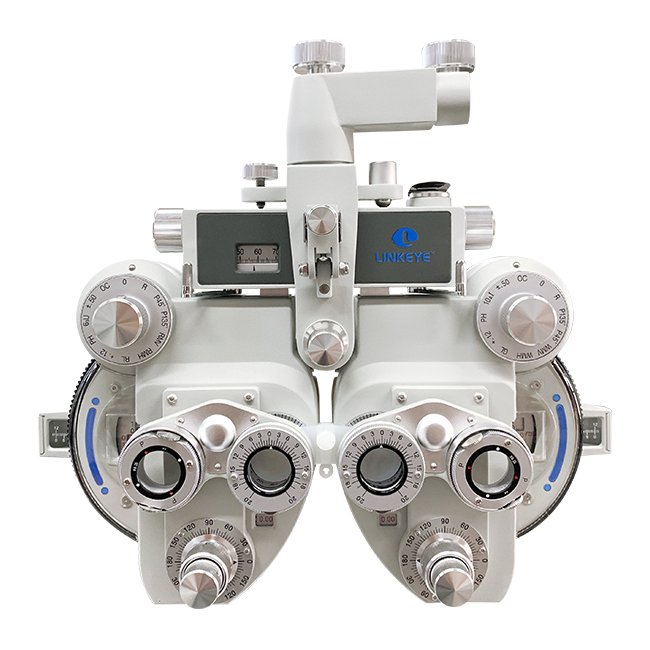
- Top-grade quality View Tester
- Elegant design of butterfly-shape appearance
- High grade plated-film used in all optic lenses
- Two colors for option
Final Recommendation
For new clinics balancing budget and reliability, a certified manual phoropter from a trusted global supplier like Shanghai LINK Instruments offers the best of both worlds: clinical-grade performance, regulatory assurance, and long-term support.
FAQs
1. Can manual phoropters be used for pediatric patients?
Yes, manual phoropters can be used for pediatric patients, especially cooperative school-aged children and older, but they require patience and are less ideal for infants or uncooperative toddlers who may need alternative methods like trial frames or autorefractors for quicker, more objective results, as manual refraction relies heavily on the child’s ability to communicate and sit still.
2.What is the difference between manual and automatic phoropter?
A manual phoropter requires the eye doctor to physically turn dials to change lenses for vision testing, while an automatic (digital) phoropter uses motorized, computer-controlled adjustments, offering faster, more precise, and consistent results, digital data integration, and easier comparison between prescriptions, reducing clinician strain and improving patient experience.
3.What is the purpose of a phoropter?
The phoropter is a crucial eye exam tool with multiple lenses that an optometrist uses to precisely measure your refractive error (like nearsightedness, farsightedness, astigmatism) and binocular vision to determine your exact eyeglass or contact lens prescription for clear, comfortable vision.
4. Is it difficult to train staff on using manual phoropters?
Yes, it is considered difficult and time-intensive to train staff to use manual phoropters proficiently. The process requires a deep understanding of optical principles and significant hands-on practice to achieve reliable and repeatable results.
5. Are manual phoropters compatible with digital chart systems?
Many models, including those from Shanghai LINK, support integration with digital visual acuity charts.
6.Which type of refractometer is suitable for a clinic?
The ideal choice depends on practice goals, but an integrated approach using both often yields the best results for accuracy and patient satisfaction, as auto-phoropters excel at quick comparisons and data linking, while manual fine-tuning remains crucial for complex cases. You can get a more detailed introduction from another blog “Auto Phoropter vs Manual: Which Is Better for Clinics?” on LINK.


