
Accurate intraocular pressure (IOP) measurement is essential for diagnosing and managing glaucoma. Devices like the Shanghai Link Tonometer, based on the Goldmann Applanation Tonometer (GAT) principle, provide precise and reliable IOP readings. This article explains the GAT working principle and its clinical applications.
What Is the Goldmann Applanation Tonometer?
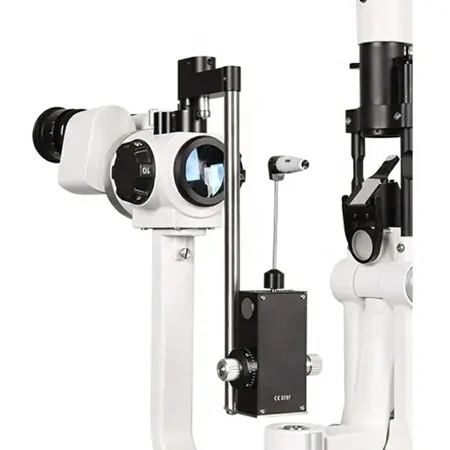
Tonometry is an eye test that measures the pressure inside your eyes, to determine whether or not you may be at risk for glaucoma.The Goldmann Applanation Tonometer is a device attached to a slit lamp that measures the force required to flatten a small, defined area of the cornea. It quantifies IOP by assessing the resistance of the eye to indentation, providing an objective measurement critical for glaucoma diagnosis.
The Core Principle: Imbert-Fick Law
This principle, originally formulated in the late 1800s, states that for a perfectly thin, dry, elastic, and spherical membrane, the pressure (P) inside the sphere is equal to the force $(F)$ required to flatten a specific surface area (A). This relationship is expressed by the simple formula:
In the context of the eye, P represents the Intraocular Pressure (IOP) within the globe. The GAT indirectly measures this pressure by assessing the force needed to flatten, or applanate, a tiny, fixed area of the cornea.
Goldmann’s Refinement
While the Imbert-Fick Law assumes an ideal, thin-walled sphere, the human cornea is neither perfectly thin nor purely elastic. It has intrinsic resistance to deformation (rigidity) and is covered by a tear film, which creates surface tension.
Dr. Goldmann’s genius was realizing that if the diameter of the flattened area was fixed at 3.06 mm, the counteracting forces of corneal rigidity (which tends to give a falsely high reading) and the tear film’s surface tension (which tends to give a falsely low reading) would effectively cancel each other out—assuming a normal central corneal thickness (CCT) of approximately 520 micrometers (μm). This calculated applanation area makes the GAT highly accurate and the standard for IOP measurement.
How Does the Goldmann Applanation Tonometer Work?
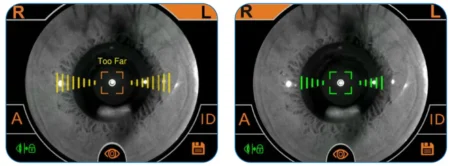
For a visual demonstration of the procedure, you might find this video helpful: An introduction to Goldmann Applanation Tonometry. This YouTube video provides a step-by-step guide to performing Goldmann Applanation Tonometry.
Key Applications of Goldmann Applanation Tonometry
GAT’s accuracy and reliability have cemented its role in virtually all areas of ophthalmic care. Its primary applications include:
1. Glaucoma Screening and Diagnosis
Glaucoma is a progressive optic neuropathy, often—though not exclusively—associated with elevated IOP. As high IOP is the only modifiable risk factor for the disease, regular GAT measurements are essential for:
-
Routine Screening: Detecting elevated IOP in asymptomatic patients, especially those over 40 or with a family history of glaucoma.
-
Diagnosis: Confirming ocular hypertension (OHT) and various forms of glaucoma.
2. Management and Follow-up
For patients diagnosed with OHT or glaucoma, GAT is used to:
-
Monitor Treatment Efficacy: Tracking IOP changes in response to prescribed medication (drops) or surgical interventions.
-
Disease Progression: Sustained or fluctuating high pressures can indicate that the disease is progressing, prompting a change in treatment strategy.
3. Other Ocular Conditions
GAT is also necessary for diagnosing and managing numerous other conditions that can cause IOP elevation, such as:
-
Uveitis (eye inflammation)
-
Posner-Schlossman Syndrome
-
Ocular trauma and infection (in cases without globe rupture)
-
Assessment before and after eye surgery.
Advantages of the Goldmann Applanation Tonometer
Goldmann Applanation Tonometry is currently considered to be the Gold Standard method of measuring the pressure inside your eyes (the intraocular pressure or IOP).
Advantages include:
Limitations to Consider
Where to buy Goldmann Applanation Tonometers?
Shanghai Lingke Instruments Co., Ltd. produces applanation tonometers based on the Goldmann principle and manufactures ophthalmic equipment in compliance with ISO and FDA standards. Their devices combine precision engineering with ergonomic design, supporting ophthalmologists worldwide in delivering accurate diagnostics.
Conclusion
The Goldmann Applanation Tonometer measures the force required to flatten a small area of the cornea, providing essential data for glaucoma assessment. Instruments based on this principle, including those from LINK Tonometer, remain the clinical standard for reliable intraocular pressure measurement.
Popular tonometers in 2025:
- YZ30R Applanation Tonometer
- NCT-5000AB Non Contact Air Puff Tonometer
- ST-1000 Automatic Air Puff Non-Contact Tonometer
FAQs
1. Is the Goldmann Applanation Tonometer painful?
Electronic indentation or applanation tonometry involves an instrument touching the eye that may cause mild discomfort. An optometrist may choose to use numbing eye drops for contact tonometry tests to lessen discomfort. Non-contact tonometry is available as an alternative.
2.Why the Goldmann Tonometer Is Considered the Gold Standard?
The reasons are practical and evidence‑based:
• Long‑term clinical validation
• High reproducibility between operators
• Minimal calibration drift
• Good tolerance in most patients
• Excellent correlation with manometric measurements
For these reasons, most international clinical guidelines still consider GAT the benchmark for glaucoma diagnosis and follow‑up.
3. How often should IOP be measured in glaucoma patients?
Quarterly IOP measurement is, for most optometric physicians, considered to be the standard of care. Of course, if there is a significant deviation from the target IOP, and particularly if compliance is an issue, I would recommend more frequent visits.


