
A phoropter is the main tool used to check a patient’s prescription. It is usually either manual or automatic. Both types do the same basic job—measuring refractive error to find the right lenses. But manual and auto phoropter differ significantly in operation, features, and suitability. This article compares these two types of phoropters, helping you decide which is better for your practice.
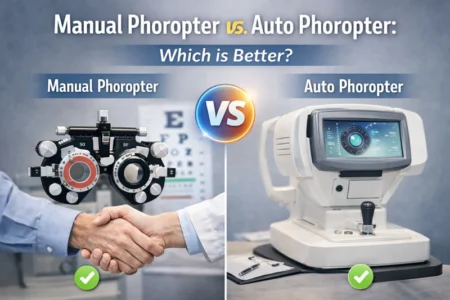
What Is a Manual Phoropter?
A manual phoropter is a traditional optometry instrument used during subjective refraction, allowing optometrists to manually adjust lenses while patients compare visual clarity. It relies heavily on practitioner expertise and patient feedback, making it a trusted tool in clinical settings for decades.
How it works
Lens selection: It contains multiple lens combinations (spherical, cylindrical, prisms) that are manually rotated in front of the patient’s eyes.
Subjective testing: The optometrist changes lenses and asks the patient which view is clearer (e.g., “Which is better, one or two?”).
Fine-tuning: Based on patient feedback, the doctor fine-tunes the lenses to achieve the sharpest, most comfortable vision.
Key Features and Benefits
Manual phoropters are mechanical devices operated by rotating dials and levers. Their notable advantages include:
- Precision control: The optometrist directly manipulates lens power and cylinder axis.
- Components: Includes adjustable dials for sphere, cylinder, and axis, plus prisms for binocular vision.
- Durability: Fewer electronic parts mean less risk of malfunction and longer service life.
- Cost-effectiveness: Lower initial investment makes them accessible for smaller practices.
- Simplicity: Easy to maintain with minimal technical support.
However, manual phoropters require greater skill and can prolong examination times, especially in busy clinics.
What Is a Auto Phoropter?
The Auto Phoropter is a computerized, high-tech version of the traditional eye chart device that rapidly measures your vision to determine the most accurate eyeglass prescription, automating lens changes and providing digital data for better doctor-patient interaction and faster, more precise results. It uses fluidic lenses and sensors to assess refractive errors like nearsightedness, farsightedness, and astigmatism, replacing the manual lens-flipping process with digital controls.
How it Works
- Objective Measurement: The device sends light into the eye, which reflects off the retina, allowing sensors to detect and measure refractive errors like defocus and astigmatism.
- Automated Correction: Using a fluidic lens system, it instantly adjusts lens power to correct distortions, providing an objective starting point for the prescription.
- Subjective Refinement: The optometrist uses a tablet or controller to fine-tune the prescription by presenting different lens combinations, asking, “Which is better, one or two?”.
- Data Integration: It seamlessly connects with auto refractors and lensmeters, importing initial readings and managing patient data for a streamlined exam.
Key Features and Benefits
Manual phoropters are mechanical devices operated by rotating dials and levers. Their notable advantages include:
- Speed & Accuracy: Faster lens changes and more precise measurements, reducing exam time.
- Better Comparisons: Easily shows patients how new lenses compare to previous prescriptions.
- Comprehensive Testing: Tests for near vision, multifocals, and binocular vision more effectively.
- Patient Comfort: Less physical effort for the doctor, allowing more focus on the patient and potentially reducing patient anxiety.
In essence, it’s a modernized, digital upgrade to the standard phoropter, making eye exams quicker, more accurate, and more comfortable for both patients and practitioners.
Key Differences Between Manual and Auto Phoropters
| Feature | Manual Phoropter | Auto Phoropter |
| Initial Cost | Low to Moderate | High |
| Learning Curve | High (Requires manual skill) | Moderate (Requires tech training) |
| Workflow Speed | Moderate | Fast |
| Maintenance | Low (Mechanical cleaning) | Moderate (Software/Electronics) |
| EHR Integration | None (Manual Entry) | Full Integration |
Manual vs. Auto Phoropter: Which Is Better?
- For Efficiency & Accuracy: Automated phoropters win, offering significant time savings and fewer errors, allowing doctors to see more patients.
- For Practice Type: Digital suits larger, busy practices; manual might suffice for smaller ones.
- For Clinician Feel: Personal preference plays a role; some love the hands-on feel of manual, while others prefer digital ease.
In essence, the industry trend favors digital for its modern efficiency and accuracy, but the “best” choice depends on a practice’s specific needs, budget, and the clinician’s preference, with manual phoropters representing older, reliable technology.
Expert Insight
 |
 |
The Verdict: Which is Better for You?
It’s depends entirely on your business model:
- Choose a Manual Phoropter:You are a solo practitioner who prioritizes the traditional “art” of refraction, you have a limited budget, or you want a device that will never suffer from a software glitch.
- Choose an Auto Phoropter:You run a high-volume clinic, you want to minimize data entry errors, or you want to provide a high-tech, premium patient experience that integrates seamlessly with your digital ecosystem.
While manual refractometers are convenient, the industry trend is towards automation. For most modern clinics seeking to scale, automated refractometers represent a superior long-term investment option in terms of both efficiency and ergonomics by 2026.
FAQs
Q1: Can auto phoropters be used for pediatric patients?
Yes, auto-phoropters and autorefractors are used for pediatric patients, especially handheld or animated versions, because they efficiently measure refractive error in children who struggle with traditional, subjective methods, though cycloplegic (drops) autorefraction is often needed for accuracy in young kids to overcome strong focusing. While automated results are great for screening and initial data, they’re often combined with manual subjective exams or cycloplegic retinoscopy for confirmation, as children’s accommodation (focusing) can make results fluctuate.
Q2: Who would use an autorefractor?
An autorefractor is a machine that opticians use to measure how light changes as it comes into the eye, giving an accurate estimate of your prescription. It’s a great starting point for your optician to then carry out the rest of their tests and final refinement of your prescription during your visit.
Q3: What are the limitations of auto refractometer?
They quickly provide sphere, cylinder, and axis measurements but have limitations for high refractive errors, media opacities, and near refraction. Alignment, cooperation, and irregular astigmatism can also impact results.
Q4: Can phoropters integrate with other ophthalmic equipment?
Yes, modern digital phoropters readily integrate with other ophthalmic equipment, allowing seamless data transfer with autorefractors, keratometers, retinal imagers, and Electronic Health Record (EHR) systems to automate exams, reduce errors, and create a comprehensive patient profile.
Q5: Is a phoropter a type of ophthalmoscope?
No, a phoropter is not an ophthalmoscope; a phoropter (or refractor) measures your vision to find your eyeglass prescription, while an ophthalmoscope (or funduscope) allows a doctor to look inside the back of your eye (fundus) to check eye health and diagnose diseases like glaucoma or diabetic changes. They are different ophthalmic tools used for distinct purposes during an eye exam, though both are essential for comprehensive eye care.


