





This guide covers how to calibrate, disinfect and service a tonometer, from Goldmann prisms to handheld rebound units, with a maintenance schedule clinics can copy. A tonometer needs three routines: calibration checks, disinfection between patients, and a written service schedule. For Goldmann-type units, check calibration at 0, 20 and 60 mmHg, and disinfect prisms by soaking them in 10% bleach for 5 minutes.[1] Handheld and non-contact units follow the manufacturer’s schedule.
Why Calibration Matters for Every Eye Pressure Device
An uncalibrated eye pressure test machine gives a confident wrong number, whether it is a Goldmann prism, a handheld probe or a non-contact unit.
The margin is narrow
The accepted range is 10 to 21 mmHg, and StatPearls states that tonometers must be properly calibrated.[2] A drift of a few mmHg can push a healthy patient over the line or hide a risky one. For the full picture, read какое глазное давление считается нормальным.
The cost of skipping it
- False ocular hypertension referrals
- Missed pressure spikes after treatment
- Poor comparison between visits and clinicians
How to Check a Goldmann Tonometer
Run the check with the calibration bar, and write the result down.

| Dial position | Test pressure | What to do |
|---|---|---|
| 0 | 0 mmHg | Confirm the balance reads zero |
| 2 | 20 mmHg | Mid-range check on the normal-to-high border |
| 6 (calibration arm) | 60 mmHg | High-end check |
Keeler’s instructions for use list exactly these steps: the drum at 0, the drum at 2, and the calibration arm at 6.[3] If any point is off beyond the tolerance printed in your manual, stop using the unit and send it for service. How often to check is a judgment call; follow the manufacturer’s advice and log every check.
Disinfection That Does Not Wreck the Prism
Disinfect after every patient, and choose a method the tip can survive.
Method
- Wipe debris off the prism
- Soak in 10% bleach for 5 minutes
- Rinse and dry completely
- Store dry and covered
Why not alcohol alone
Wipes are easier, but 70% isopropyl alcohol and 3% hydrogen peroxide do not reliably destroy some viruses. Tonometer tips have been linked to clusters of epidemic keratoconjunctivitis.
Tip damage
Every disinfectant can swell or crack a prism by dissolving its glue. In AAO-reviewed testing, 70% isopropyl alcohol soaks did the worst damage.[4] Inspect each tip for cracks before the next patient.
Rinse and field check
A New South Wales hospital procedure calls for rinsing prisms under running water for 10 to 15 minutes, and for a monthly prism field check recorded with lot numbers.[5]
Handheld and Non-Contact Units: What Changes
Handheld units trade a calibration bar for consumables and batteries.
Tip-cover and rebound devices
- Use only the maker’s tip covers or probes
- Replace batteries before readings drift
- Keep a spare unit or probes in the cabinet
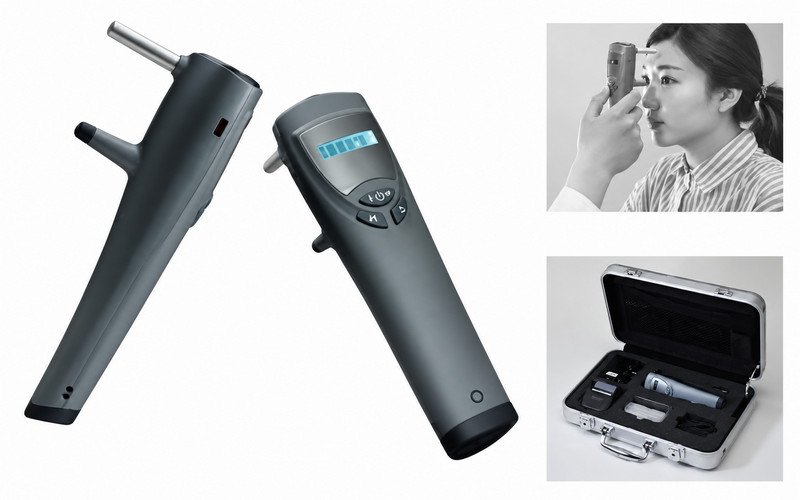
The Reichert Tono-Pen AVIA uses disposable Ocu-Film tip covers and, per Reichert, needs no manual calibration.[6] LINKEYE’s SW-500 rebound unit measures 3 to 70 mmHg with an error of ±1.5 mmHg up to 25 mmHg and ±2.5 mmHg above, and runs on two AA batteries.[7] Non-contact units need a clean air nozzle and the supplier’s model-eye check, if one is provided.
Keep a Log, Not Just a Habit
A tonometer log takes two minutes a week and settles every dispute later.
What to record
- Date and operator
- Calibration result at each test point
- Prism or tip lot number
- Repairs, replaced parts and service dates
Запасные части
Keep a second prism or tip set so one can soak while the other is in use. Clinics that run only one set end up rushing the soak, which is the step that matters most.
A Maintenance Schedule Clinics Can Copy
Treat this as a starting point and override it with your manual.
| Task | When | Applies to |
|---|---|---|
| Disinfect tip or prism | After every patient | All contact tonometers |
| Inspect for cracks or wear | Daily | Prisms, probes, tip holders |
| Wipe housing and lens | Daily | All tonometers |
| Calibration check | Monthly, and after any knock | Goldmann-type units |
| Battery check | Weekly | Handheld units |
| Professional service | Yearly | All tonometers |
Troubleshooting a Drifting Tonometer
Four quick checks solve most complaints.
- Readings read high on every patient: check zero and the prism seat
- Dial sticks: stop and send for service
- Readings jump between attempts: replace the tip cover or probe
- Battery warning: swap cells before the next patient
When to Repair, When to Replace
Retire an eye pressure test machine when repairs stop holding.
- Calibration fails twice after servicing
- The prism or housing is cracked and no spare is available
- Spare parts are no longer supplied
- Servicing costs approach the price of a new unit
Distributors should confirm spare-part availability for at least several years before stocking a model. A cheap unit without parts is not cheap.
Best Pick for Clinics and Distributors
If you want a handheld eye pressure device that skips bar calibration and keeps maintenance simple, start with LINKEYE’s тонометр range.[8] Ask any supplier for the maintenance manual, spare-part list and warranty before you order. Send us your clinic type and we will recommend a model.
Вопросы и ответы
How often should a tonometer be calibrated?
Follow the manufacturer’s schedule. Goldmann applanation tonometers should be checked for calibration monthly (or at least twice yearly according to some guidelines), though devices less than one year old can be checked twice yearly, while older units require monthly checks.
How do you disinfect a Goldmann tonometer prism?
Soak it in 10% bleach for 5 minutes, rinse, dry completely and inspect it for cracks.
Is there a machine to check eye pressure at home?
Yes, portable devices called tonometers can measure intraocular pressure (IOP) at home, though they typically require a prescription and proper training from an eye care provider.
What Is Normal Eye Pressure?
Normal eye pressure—also called intraocular pressure (IOP)—typically falls between 10 and 21 millimeters of mercury (mmHg).
Can an eye pressure device be serviced locally?
Basic cleaning and battery changes can be done in-house. Calibration repair and prism replacement should go through the supplier.
Список литературы
[1] American Academy of Ophthalmology. How to Disinfect and Calibrate Your Tonometer. EyeNet Magazine, May 2018.
[2] StatPearls Publishing. Тонометрия. NCBI Bookshelf, National Library of Medicine, 2026.
[3] Keeler. Applanation Tonometer Instructions for Use, Issue D. Bio-Clinical Services, accessed November 4, 2026.
[4] American Academy of Ophthalmology. Disinfection of Tonometers: A Report by the American Academy of Ophthalmology. Hosted by the College of Physicians and Surgeons of Alberta, accessed November 4, 2026.
[5] South Eastern Sydney Local Health District. Tonometer Disinfection and Prism Field Check, SESLHDPR/366. Procedure, revision 1, November 2015.
[6] Reichert Technologies. Tono-Pen AVIA Applanation Tonometer. OphthalmologyWeb listing, accessed November 4, 2026.
[7] Shanghai LINKEYE. Ручной офтальмологический тонометр SW-500. Product page, modified August 19, 2026.
[8] Shanghai LINKEYE. Ophthalmic Tonometer Machines. Category page, accessed November 4, 2026.


