




For most clinics, the best air puff machine is a 0–60 mmHg range, a built-in printer and local technical support. Larger practices may also need features like pachymetry, DICOM connectivity, or corneal-compensated measurements.
What Is an Air Puff Machine Used For?
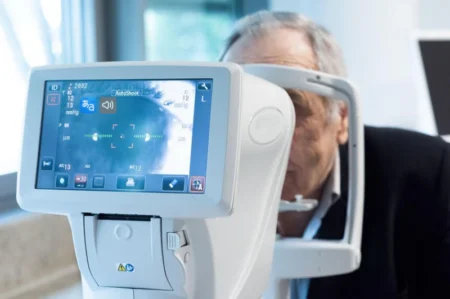
An air puff test is a form of tonometry—a test for measuring how much fluid pressure is inside your eyes (otherwise known as intraocular pressure). More specifically, this test is a form of non-contact tonometry, meaning it allows optometrists to measure intraocular pressure without physically touching the eye. It requires no anaesthetic drops and does not touch the ocular surface, making it practical for rapid screening in optical stores, clinics and hospitals.
Demand for efficient screening is substantial. A 2014 meta-analysis estimated that glaucoma affected 64.3 million people aged 40–80 in 2013, projected 76 million cases for 2020 and 111.8 million by 2040.
For an explanation of the measurement process and routine faults, see What Is an Air Puff Tonometer? Uses and Troubleshooting Guide.
How to Choose an Air Puff Machine?
Choose the machine around patient volume, clinical workflow and after-sales capacity. Five features deserve close scrutiny:
- Measurement range and repeatability: A 0–60 mmHg range covers routine and elevated readings. Ask the supplier for accuracy, repeatability and calibration evidence—not merely a broad range.
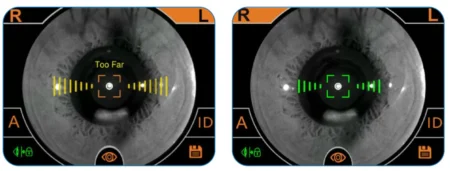
- Automatic positioning: Three-dimensional alignment, autofocus and automatic right/left eye switching reduce operator variability and accelerate busy pre-test workflows.
- Patient safety: Look for an 11 mm working distance, a proximity stop or alarm, and automatic air-jet self-testing at startup.
- Corneal thickness support: Central corneal thickness can influence NCT readings. In a 105-patient study, each 10 μm increase in thickness was associated with a 0.46 mmHg increase in NCT-measured IOP (Moorfields Eye Hospital study, June 2005). Pachymetry is therefore useful when readings require clinical context.
- Data handling: A thermal printer suits independent practices. Hospitals should also check USB, LAN, RS-232 or DICOM compatibility before ordering.
Which Models Offer the Best Fit?
“Best” depends on the intended workflow. These options illustrate 2 distinct purchasing levels.
| Модель | Best for | Notable features | Published price |
|---|---|---|---|
| LINK ST-1000 | Routine clinic screening | 1–60 mmHg, automatic 3D positioning, 10.1-inch display, printer, optional corneal thickness measurement | Request a quotation |
| LINK NCT-5000AB | High-volume or connected clinics | 0–60 mmHg, fully automatic bilateral testing, rotating 7-inch screen, printer, DICOM 3.0, optional data storage | Request a quotation |
The ST-1000 prioritises straightforward testing and printed records. The NCT-5000AB better serves facilities requiring network integration and greater automation.
How Much Does an Air Puff Machine Cost?
Public US prices checked on July 20, 2026 show how widely costs vary. The Keeler IntelliPuff was listed at US$5,865, while the Reichert 7CR was US$8,755 (Veatch Ophthalmic; Reichert online store). Factory-direct models are commonly quote-based because voltage, software, accessories, destination and order volume affect the final amount.
What Should the Quotation Include?
- Machine and standard accessories
- Freight, insurance, duties and tax
- Installation, training and calibration support
- Warranty term, response time and spare-part availability
- Instrument table, printer paper and software integration
Compare total landed cost, not the device price alone.
When Is Non-Contact Tonometry Appropriate?
An air puff machine is appropriate for preliminary IOP measurement and high-throughput case finding. It should not be presented as a stand-alone glaucoma diagnostic device. NICE states: “Do not base a decision to refer solely on IOP measurement using non-contact tonometry” (NG81, updated January 26, 2022). Suspicious results require professional interpretation alongside Goldmann-type applanation tonometry, optic nerve assessment and visual-field testing.
Final Recommendation: What Is the Best Choice?
For most independent clinics, the ST-1000 is the best value-oriented choice. Select the NCT-5000AB when automation, DICOM connectivity and high patient throughput justify the upgrade. Before paying, request a model-specific certificate package, live video demonstration, written warranty and complete landed-cost quotation.
Часто задаваемые вопросы
Is an air puff machine accurate?
Air puff machines (non-contact tonometry) are accurate enough for general eye exams and glaucoma screening. However, abnormal results need confirmatory assessment.
Does an air puff test require anaesthetic drops?
No, an air puff test does not require anesthetic drops. Because it is a non-contact method that uses a gentle burst of air to measure eye pressure, nothing ever touches your eye. .
Is pachymetry necessary?
It is not essential for every screening, but it gives valuable context because corneal thickness can influence measured IOP.
How often should the machine be calibrated?
Follow the manufacturer’s prescribed verification and calibration schedule. Arrange an additional check after relocation, impact or persistently inconsistent readings.
What warranty should a buyer request?
Request at least a written one-year warranty covering manufacturing defects, together with response times, remote support terms and a spare-parts policy.


