





Resumen: This guide compares five handheld tonometer suppliers, explains the three technologies behind them, and shows clinics, hospitals and distributors what to check before buying.
Trusted handheld tonometer suppliers include LINKEYE, Icare, Reichert, Kowa and Clement Clarke. Their devices use three technologies: rebound (LINKEYE SW-500, Icare IC200), tip-cover applanation (Reichert Tono-Pen AVIA) and spring-driven Goldmann-type applanation (Kowa HA-2, Perkins). The right choice depends on patient position, running costs and how closely readings must match Goldmann.
Market Snapshot of Tonometer
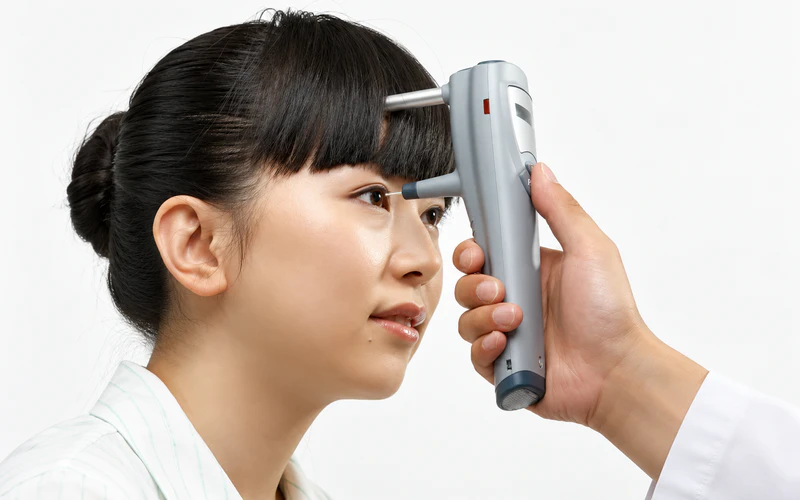
The global tonometers market was $398.4 million in 2025, with a projected market size of $424.8 million in 2026 and $644.2 million by 2035, a 4.7% CAGR. Applanation models earned the most revenue, at USD 233.3 million in 2025; rebound models followed at USD 82.1 million.[1]
What that means for buyers:
- Applanation remains the clinical gold standard
- Portable applanation units are gaining ground in remote settings
- Rebound tonometers are the smaller, lighter alternative
Three Handheld Technologies Compared
Whether you call it a tonometer or an eye pressure monitor, each technology trades accuracy against convenience.
| Technology | Principle | Ejemplos |
|---|---|---|
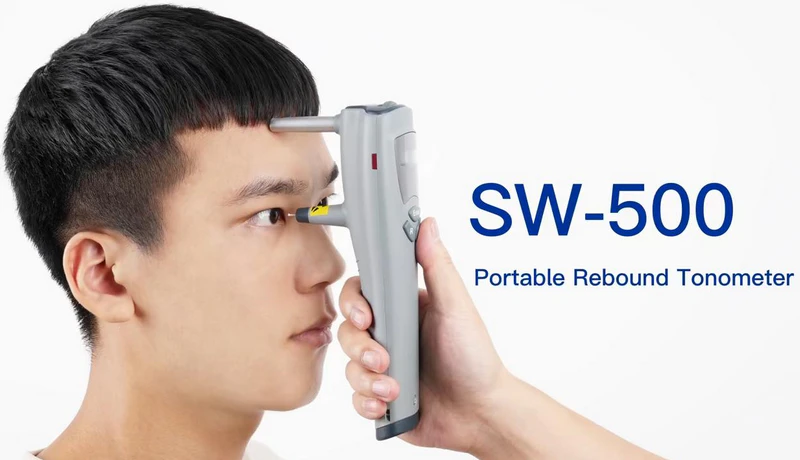
| Rebound | A light probe touches the cornea briefly; its motion gives the pressure | LINKEYE SW-500, Icare IC200 |
| Tip-cover applanation | A micro strain gauge taps the cornea through a disposable cover | Tono-Pen AVIA |
| Goldmann-type applanation | A prism flattens a fixed corneal area | Kowa HA-2, Perkins |
For the reference method itself, read how the Goldmann applanation tonometer works.
Handheld Applanation Tonometer or Rebound: When Each Wins
Pick by patient, not by brochure.
Choose a handheld applanation tonometer when
- Readings must track the Goldmann applanation tonometer closely
- Tip covers or prism heads are already in your stock room
- The unit backs up a slit lamp-mounted Goldmann
Choose rebound when
- Children, older adults or bedridden patients dominate the schedule
- You want to skip anesthetic drops
- New staff need guidance: the IC200 signals when the probe sits perpendicular to the cornea
Neither type replaces a full glaucoma work-up. A single pressure reading is a screening step, not a diagnosis.
Supplier Profiles
1. LINKEYE: Factory-Direct Rebound and Applanation Units
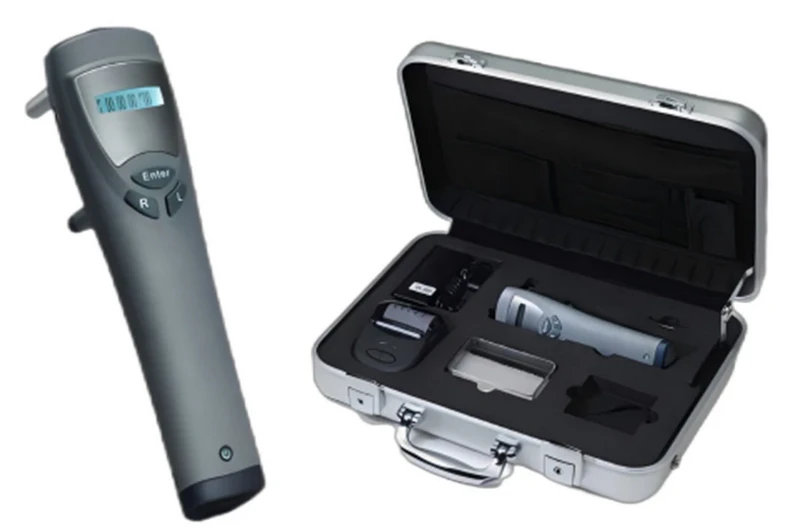
LINKEYE’s SW-500 is a one-hand tonómetro portátil that measures 3 to 70 mmHg, with an error of ±1.5 mmHg from 3 to 25 mmHg and ±2.5 mmHg above that. It runs on two AA batteries and ships with a carrying case and a wireless printer.[2] One reviewing ophthalmologist notes that very squirmy patients may need a second attempt. The range also includes the SW-1200 and SW-1200A rebound units, AP-1 and YZ30R applanation tonometers, and two non-contact models.[3]
Distributor terms: a 1–3 year warranty, free voltage and plug customization, delivery in 5–10 working days for most countries, and discounted or non-branded units.
2. Icare: Rebound Specialist
Icare, based in Finland, built its name on rebound tonometry. The IC200 needs no anesthetic drops or air puff and works with 200 degrees of positional freedom, so patients can be seated, reclined or supine.[4] Its range is 7 to 50 mmHg, and an FDA-listed study compared it with Goldmann across 152 eyes.[5]
3. Reichert: The Tono-Pen Standard
The Tono-Pen AVIA weighs 71 g, measures 5 to 55 mmHg, needs no calibration and uses disposable Ocu-Film tip covers. Reichert makes it in the USA and states its readings correlate strongly with Goldmann.[6]
4. Kowa: A Goldmann Prism in Your Hand
The Kowa HA-2 works on the Goldmann prism principle with a spring mechanism that reads correctly in any orientation. It weighs 240 g, has built-in illumination and covers 0 to 60 mmHg.[7]
5. Clement Clarke: The Perkins Tonometer
The Perkins, made by Clement Clarke in Great Britain, is a handheld Goldmann-method tonometer with a 0 to 50 mmHg scale.[8] It suits domiciliary visits and back-up use.
Which Handheld Tonometer Fits Your Practice?
Use the table below to shortlist, then test one unit.
| Proveedor | Modelo | Range (mmHg) | Peso |
|---|---|---|---|
| LINKEYE | SW-500 | 3–70 | Not listed |
| Icare | IC200 | 7–50 | Not listed |
| Reichert | Tono-Pen AVIA | 5–55 | 71 g |
| Kowa | HA-2 | 0–60 | 240 g |
| Clement Clarke | Perkins | 0–50 | Not listed |
Patient position
Bedridden and pediatric patients rarely sit at a slit lamp. Icare’s 200 degrees and Kowa’s any-orientation spring cover that.
Running costs
- Tip covers for Tono-Pen units
- Disposable probes for rebound units
- Prism heads for Goldmann-type units
- Batteries and printers
Accuracy reference
Whichever eye pressure monitor you buy, check readings against a Goldmann unit before it goes into routine use.
Distributor terms
Ask about warranty length, plug and voltage options, and branding. LINKEYE lists all three. Order consumables with the first shipment, so the devices never sit idle waiting for probes or covers.
Best Pick for Clinics and Distributors
For clinics and distributors who want a rebound handheld tonometer at factory pricing, with customization and a wide measuring range, start with the LINKEYE SW-500. For patients who must be tested lying down, shortlist Icare. For a Goldmann-type reading in a portable body, choose Kowa or Perkins. Send us your volume and patient mix and we will recommend a model.
Preguntas frecuentes
What is a handheld tonometer?
A handheld tonometer is a portable device that measures intraocular pressure, typically with rebound or applanation technology.It plays a crucial role in screening, diagnosing, and managing glaucoma.
Is a handheld applanation tonometer as accurate as a Goldmann tonometer?
Readings correlate, but the Goldmann remains the reference. Reichert states the Tono-Pen AVIA correlates strongly with Goldmann.
Do rebound tonometers need anesthetic drops?
No, rebound tonometers do not require anesthetic eye drops. Check each model’s instructions.
What measuring range should a handheld tonometer cover?
Listed ranges run from 0–60 mmHg on the Kowa HA-2 to 3–70 mmHg on the LINKEYE SW-500.
Can LINKEYE supply non-branded handheld tonometers?
Yes. LINKEYE lists discounted, non-branded or customized products for distributors.
Referencias
[1] Global Market Insights. Tonometers Market Size and Share, 2026–2035. Accessed October 18, 2026.
[2] Shanghai LINKEYE. SW-500 Tonómetro de rebote oftálmico de mano. Product page, modified August 19, 2026.
[3] Shanghai LINKEYE. Ophthalmic Tonometer Machines. Category page, accessed October 18, 2026.
[4] Icare Finland Oy. Tonómetro iCare IC200. Product page, accessed October 18, 2026.
[5] U.S. Food and Drug Administration. Icare ic200, 510(k) K190316. Innolitics FDA database, cleared January 14, 2020.
[6] Reichert Technologies. Tono-Pen AVIA Applanation Tonometer. OphthalmologyWeb listing, accessed October 18, 2026.
[7] Kowa Optimed, Inc. Kowa Applanation Tonometer HA-2. OphthalmologyWeb listing, accessed October 18, 2026.
[8] Redalyc. Ex vivo and in vivo study of Kowa HA-2 applanation tonometer. Journal article, accessed October 18, 2026.


